

Endometriosis vs fibroids – what to know, and when to see a Gynaecologist


When we’re talking about endometriosis vs fibroids, we’re talking about two common, yet very different women’s health conditions.
Both can present with similar symptoms – including heavy and painful periods – but they impact your body in very different ways.
And if we’re looking for clarity on anything symptom-related, guidance is always best sought from expert sources. So, we sat down with Renee Behrens – Gynaecologist at Sarum Road Hospital – part of the renowned Circle Health Group, in Winchester, Hampshire, for her specialist insight.
Read on for her guidance on:
- symptom-spotting
- having both at the same time
- different diagnostic testing you might be offered
- when to see a gynaecologist
Plus, much more. Before we get into it – Circle Health Group encompasses the UK’s largest national network of private hospitals, and offers top-notch specialist expertise and patient experience across a wide range of women’s health services. Circle Health Group has over 50 hospitals across the UK with over 6,500 consultants choosing to work at their facilities, seeing over 2 million patients each year. They are multi-award winning, including winning the Health Investor ‘Private Hospital Group of the Year’ in 2021, 2022, 2023 and 2024.
Hop over to their website to learn more, and find a gynaecologist near you.
Now, over to Renee.
What’s the difference between endometriosis and fibroids?
The difference between endometriosis and fibroids lies mainly in how they show up in your body.
According to the World Health Organisation (WHO), endometriosis affects around 10% (190 million) of women and girls of reproductive age globally. In endometriosis, cells similar to the lining of the womb are found outside of the uterus. These cells can appear anywhere in your body but are mostly found in your lower abdomen or pelvic area, including your ovaries, fallopian tubes, and gastrointestinal tract.
These cells grow and thicken, and then break down and bleed as your hormones change during your monthly period. Because the bleeding is unable to leave the body, this results in pain and inflammation.
On the other hand, fibroids are growths (tumours) of the muscle of the uterus and are more common as women get older. According to The National Institute for Health and Care Excellence (NICE), around 66% of women develop at least one uterine fibroid during their lifetime and 33% of women will develop symptoms.
In many women fibroids will not cause any symptoms but, depending on their location, they can result in heavy periods or an increase in the size of the uterus.
Endometriosis vs fibroids, on a deeper level
Whilst endometriosis and uterine fibroids are not related conditions, both are hormonally sensitive and respond to the hormones being produced by the ovaries during your menstrual cycle.
Endometriosis is a disease which is described as chronic – meaning it is an ongoing problem that can deeply impact your overall quality of life if it isn’t managed effectively. With the right treatment plan and lifestyle adjustments, endometriosis can be very manageable, and many women are able to live a normal, healthy life with the condition.
With uterine fibroids, it is important to know that they are not usually cancerous, and do not increase your risk of developing uterine cancer.
It is rare for fibroids to grow rapidly, and they may not need to be removed if they are not causing symptoms.
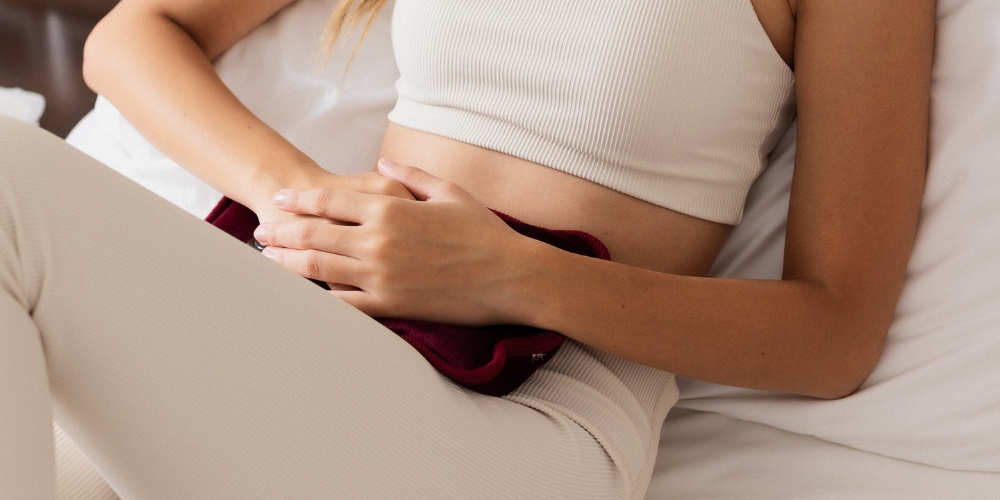
What are the symptoms of endometriosis vs fibroids?
Endometriosis and uterine fibroids, like many conditions that affect the female reproductive system, come with a range of similar symptoms that can often interfere with your everyday life.
These commonly include:
1. Heavy periods
Many women with endometriosis and uterine fibroids experience heavier than average periods which can affect quality of life and day-to-day activities.
Heavy periods, medically known as menorrhagia, are described as occurring when you need to change your sanitary towel or tampon every one to two hours, or bleeding through your bedsheets and clothes. Other signs of particularly heavy periods include passing blood clots and having a period that lasts longer than seven days.
These can be challenging and may mean you avoid daily activities, like exercise and work, because you are both physically uncomfortable and anxious about bleeding into your clothing.
2. Painful periods
Both conditions can cause severe period pain. Experiencing discomfort during your period is common, even if you don’t suffer from endometriosis or uterine fibroids, but having severe period pain is not.
This can be a shooting pain, an aching or dull pain, that lasts throughout your period and affects your daily activities. The pain might spread to your back and thighs.
Many women with endometriosis may also experience pain starting a few days before their period, or pain with sex.
The pain with fibroids is often more related to the heaviness of the period and is associated with passing clots and worse on the heavier days of the bleed. You may find that regular over-the-counter medication does not ease these symptoms.
3. Digestive and bowel issues
Both conditions can cause distressing digestive problems, with some types of endometriosis resulting in pain when going to the toilet, loose stools, bloating, and sometimes deep pelvic pain during sex.
Larger fibroids can compress the bowel and result in constipation or may cause abdominal distension from the growths.
4. Difficulty getting pregnant
Both conditions can have an impact on your fertility.
With endometriosis, the associated inflammation can result in scar tissue forming around your ovaries and fallopian tubes, making it harder to get pregnant.
You might also get endometriomas, or ovarian cysts that develop from trapped bleeding and contain old or altered blood. Also called chocolate cysts and can make the ovaries less mobile affecting the ability of the tube to pick up the egg when it is released.
Many women are able to get pregnant with uterine fibroids but, rarely, the growth might block a fallopian tube and make it more challenging to conceive. Fibroids that project into the lining of the uterus may also reduce the chance of a fertilised egg implanting.
This does not mean that you cannot get pregnant if you have either condition, but it may be less likely.
Other symptoms of endometriosis and uterine fibroids include fatigue, abdominal swelling and bloating, pain when urinating and needing to pass urine more frequently.
Does endometriosis cause fibroids?
No, endometriosis does not cause uterine fibroids. This is a myth. Both conditions can occur together, but one is not caused by the other.
However, there is another condition related to, and occasionally found alongside endometriosis known as adenomyosis.
In adenomyosis, cells similar to the lining of the uterus are found deep between the muscle fibres of the uterus resulting in an enlargement of the uterus and heavy and painful periods.
Very rarely, adenomyosis can present as a growth of uterine muscle similar to a fibroid.

Can I have fibroids and endometriosis at the same time?
Yes, it is possible to have both endometriosis and uterine fibroids at the same time.
You might mistake one set of symptoms for the wrong condition though, which is why it is important to visit your GP and/or a gynaecologist and get help as soon as possible if you have any of the symptoms we’ve covered off.
Can endometriosis be misdiagnosed as fibroids?
Whether endometriosis can be misdiagnosed as fibroids depends a little bit on your individual circumstances.
But really, if you have the right specialist gynaecologist who understands your situation and takes the time to get to know how the condition impacts your body, endometriosis should not be misdiagnosed as fibroids.
As we’ve touched on, both conditions may have similar or overlapping symptoms but with the right investigations, your gynaecologist should be able to help you towards an accurate diagnosis, plus a tailored treatment plan.
So, how can you tell the difference between endometriosis and fibroids?
Your GP or gynaecologist would first take a full and accurate history of your symptoms and concerns. They may perform an examination or take some blood tests to check for anaemia (a low blood count).
Then, they would typically recommend one or more of the following procedures.
1. Ultrasound
A pelvic ultrasound scan is usually the first-line recommendation for the majority of gynaecological concerns. An ultrasound scan is a painless test that uses a probe to produce high-frequency sound waves to create an image of the inside of your body.
This is usually performed as a transvaginal ultrasound scan (where the probe is inserted into your vagina) to visualise the uterus and ovaries but can also be performed abdominally. Ultrasound is able to see uterine fibroids or signs of endometriosis.
In some cases, further tests may include an MRI scan which uses magnetic fields to create images or even diagnostic surgery.
2. Laparoscopy
The main surgical procedure used to diagnose and treat endometriosis is a laparoscopy. This is a keyhole procedure meaning it is minimally invasive with a relatively fast recovery time.
A laparoscope is a small (5-10mm) telescope with a light and camera at one end which is inserted through your belly button and allows direct visual assessment of your abdominal cavity and pelvic organs.
During a laparoscopy, your surgeon may make further small cuts in your abdomen to allow the passage of specialist instruments to investigate or remove areas of endometriosis or scar tissue inside your pelvic area.
The sample is sent for closer examination under a microscope to confirm the diagnosis of endometriosis.
3. Hysteroscopy
If a uterine fibroid is thought to be projecting into the cavity of your womb, you may be advised to have a hysteroscopy.
Whereas a laparoscopy is performed to view and access the exterior of your uterus, ovaries, and fallopian tubes, a hysteroscopy is performed to view the internal cavity of your uterus and perform some corrective procedures.
A hysteroscope is a small telescope with a light and camera which is gently passed through the vagina and into your womb to assess the uterine cavity. If a fibroid is confirmed, then it can be removed by shaving it away under direct vision.
It may be possible to have a general anaesthetic or an injection to help you relax during the hysteroscopy, because some women find it uncomfortable and distressing.

When should I see a gynaecologist about my symptoms?
We recommend visiting a gynaecologist if:
- your symptoms are severe enough to impact your quality of life
- you are feeling exhausted or fatigued
- you have not been able to get pregnant after trying to conceive for 12 months
It is always best to discuss your symptoms with a professional and get access to the right diagnostic testing.
There are so many effective options for managing heavy periods, and your GP or gynaecologist can also discuss options for medication, lifestyle changes or even surgical solutions in some cases to help you manage your symptoms.
Keen to get to the bottom of your symptoms, and see a gynaecologist privately? Book in with a Circle Health Group specialist today.
From specialist consultations and assessments, to diagnostics, treatment, surgery and aftercare, their patient-centred, dots-joined services cover the full spectrum of women’s healthcare needs – so you’re never left wondering what’s next.