
My 101 guide: Teaching kids to dress themselves (if you’re in a flap, save it for later)

Getting dressed sounds like one of those basic life skills children should simply pick up. And yet, if you’ve ever found yourself wrestling a school jumper over a small head while someone is crying because their sock “feels funny”, you’ll know it can be anything but simple. My eldest is eight, and I still break a sweat while she’s wrestling her tights on.
Learning to dress independently takes fine motor skills, coordination, concentration, sequencing and confidence – and children develop all of these at different rates. So, if you’re teaching kids to dress themselves for school, the first thing to know is that there is no magic age when they should suddenly be able to do the whole thing without help.
Some children will happily get dressed from head to toe at four – I have a mum friend whose eldest appeared in her bedroom, fully dressed, on her first day or Reception. Others will still need help with fiddly fastenings, inside-out clothes or those impossibly tight jumper sleeves well into primary school.
And that is OK.
How old is ‘too old’, to need help?
So, at what age should a kid be able to dress themselves? There are broad developmental expectations around dressing, but they are just that – expectations, not deadlines.
A toddler may start by helping to pull up trousers or putting their arms into sleeves. By around preschool age, many children can start putting on simple clothing themselves, although they may still need help with socks, tights, buttons, zips and getting things the right way round.
By school age, many children can dress themselves with varying degrees of independence. But being physically capable of doing something doesn’t necessarily mean they will remember to do it, want to do it or be able to do it when they’re tired and distracted.
My eldest was in Year 3 before she could reliably get herself dressed upstairs, leave her room and come downstairs ready for school. My Year 2 child still struggles with tight jumper arms. Neither is unusual.
The aim isn’t to tick a box by a certain birthday. It’s to gradually build the skills and confidence they need to become more independent.

1. Start with easy clothes
If you’re teaching a child to dress themselves, don’t make life harder than it needs to be.
When they’re learning, choose softer, stretchy jersey fabrics that are easier to pull, tug and manoeuvre. Slightly looser clothes can also be much easier for little hands to deal with than stiff or tight-fitting garments.
And embrace the wonders of Velcro.
School shoes, trainers and clothing with Velcro fastenings can give children a chance to practise getting dressed without the added frustration of complicated buttons and fiddly zips. M&S, ASDA and NEXT are particularly useful for finding easy-dress children’s clothes.
There will be plenty of time for beautiful-but-fiddly top button blouses later.
2. Make buttons easier
Buttons are the tipping point of many a harassed school morning. They’re small, fiddly and require a surprising amount of fine motor control, as well as finger strength.
One little trick that can make a difference while children are learning – straight from our headteacher a few years back – is to gently widen buttonholes with a pencil. Carefully work the pencil through the buttonhole to loosen the fabric slightly, making it softer and less fiddly for little fingers.
Obviously, don’t stretch them so much that the buttons won’t stay fastened – the idea is simply to make the buttonhole a little easier to manipulate.
3. Don’t forget socks and tights…
Socks and tights: the absolute bane of my parenting life.
They look straightforward. They are not.
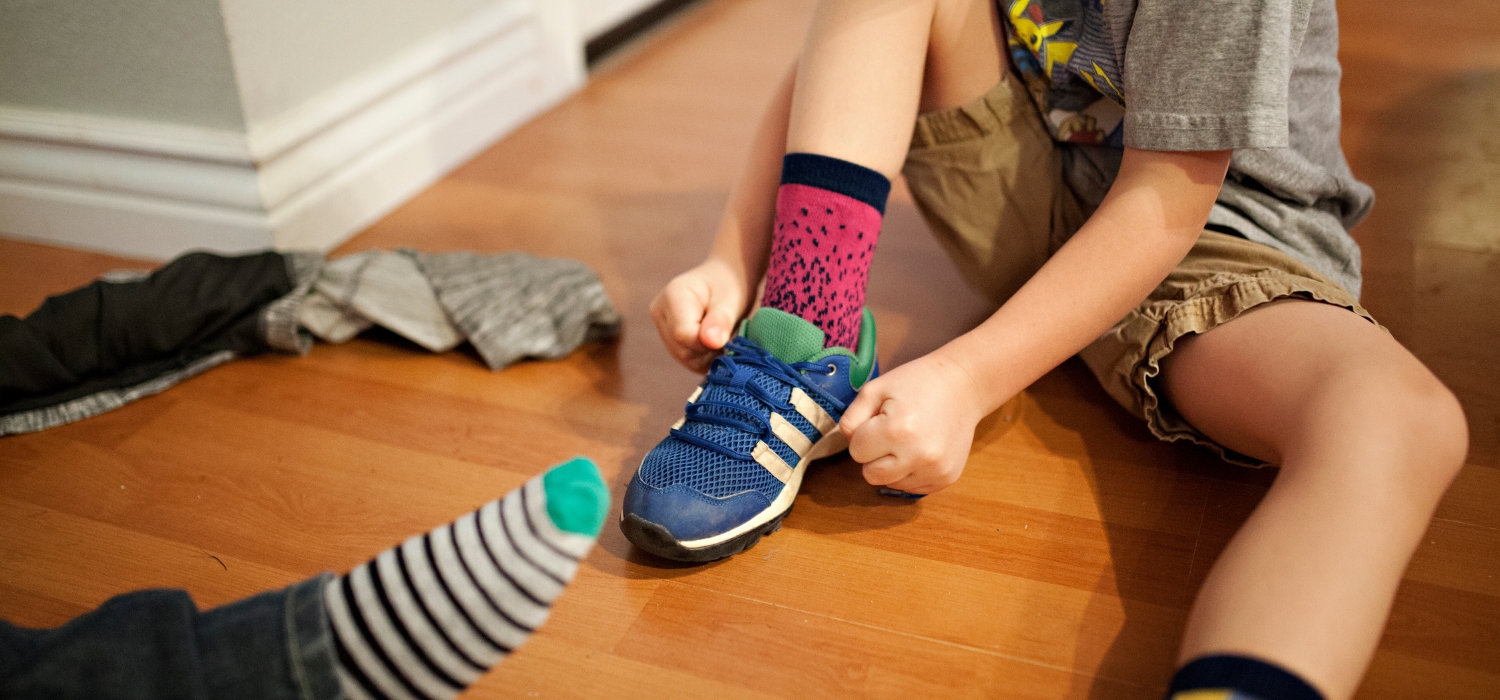
Tights in particular require coordination, strength and concentration, and getting a heel into exactly the right place can feel like a monumental task to a small child.
Break it down. Show your child how to gather the sock or tights up towards the toes first, place the toes in, then gradually pull upwards. Practise when you’re not rushing for school.
And remember that sometimes the problem isn’t unwillingness. It’s simply that the clothing is genuinely difficult to manipulate.
4. Give them somewhere quiet to get dressed
As children get older, I’ve found it much easier to encourage independence by having them get ready in their own room, away from the family hullabaloo.
The kitchen, breakfast table and hallway are generally not conducive to calm concentration when everyone is trying to find shoes, eat breakfast, brush teeth and remember where the water bottles are.
Give them a simple routine: clothes on, dirty pyjamas away, socks or tights, then into the fray.
You’ll be amazed at how much more they can manage when they’re not being distracted by everyone else.
5. Break dressing into small steps
“Go and get dressed” can be a surprisingly enormous instruction for a young child.
Instead, break it down:
- Put on your pants.
- Put on your trousers.
- Put on your top.
- Put on your socks.
- Put on your jumper (or cardigan – far easier!)
- Get your shoes.
Once the sequence becomes familiar, you can gradually step back and let them manage more of it themselves.
This can also help children who struggle with focus and concentration, because they’re only thinking about the next job rather than the whole mountain of getting ready.
6. Expect refusing and tantrums
Sometimes a child absolutely can get dressed but refuses point blank to do it.
There can be all sorts of reasons for this: they’re tired, anxious, distracted, don’t want to stop playing, dislike a particular item of clothing or simply don’t want to do something because you’ve asked them to.
Try to separate “can’t” from “won’t”. If they’re genuinely struggling with a jumper sleeve, giving them more time probably won’t solve the problem. If they’re refusing because they’d rather play football in the garden (my problem!) that’s a different issue.
Keeping the routine predictable can help. So can giving small choices: “Do you want your school dress or skirt?” rather than “Do you want to get dressed?”
7. Remember that clothing can feel very different to different children
For some children, getting dressed is considerably harder because of sensory sensitivities, coordination difficulties or differences in how they process instructions.
Certain fabrics, seams, waistbands, labels, socks or tight sleeves can be genuinely uncomfortable or distressing for autistic children, for example.
You’ll know this anyway, but if your child becomes extremely upset by particular clothes, it’s worth looking at the clothing itself rather than ploughing on with coaching. Seam-free socks, soft fabrics, loose waistbands, familiar textures and easy fastenings can all make a difference.
For any child with additional needs, the goal is still independence, but the route there may look different. Book end the good work you’re doing at home with a regular check-in at school or your childcare/education setting, letting them know how your child is getting on with dressing – and any particular pain points – so they’re aware and can support during the day.
8. Teach the coat trick
Putting on a coat independently can be another school-run stumbling block.
Try the “coat flip” method. Lay the coat on the floor with the inside facing upwards and the hood nearest to the child. Have them stand at the hood end, put their arms into the sleeves while bending down, then stand up and flip the coat over their head and shoulders.
It can take a bit of practice, but once they’ve mastered it, it’s a brilliant little independence win.
9. Practise when you’re not in a hurry
The school run is possibly the worst time to teach a new skill.
If you’re already running late and your child has put both legs into one trouser leg, that’s probably not the moment to calmly practise dressing.
Instead, practise at weekends, during the holidays or before bedtime. Let them have a go when nobody is watching the clock.
You can also let them help with one part of getting dressed before gradually adding another. That was my strategy with my eldest, and it worked really well.
10. Resist the urge to do it all for them
This is the really tricky one. When you’ve got five minutes until you need to leave, it is so much faster to grab the jumper and put it on them yourself.
And sometimes you absolutely should.
But when time allows, try to let them struggle a little. Give them the opportunity to work out how to turn a sleeve the right way round, find the neck hole or pull their trousers over their knees.
You can help without taking over: “Try putting your thumb through here” or “Can you find the opening?” gives them a prompt without doing the whole job.

Remember: independence doesn’t happen overnight
Teaching kids to dress themselves is less about reaching a magical age and more about gradually handing over responsibility.
Some mornings they’ll do everything beautifully. Other mornings they’ll emerge from their bedroom wearing one sock, a backwards jumper and yesterday’s pants (or no pants at all – it has been known in my house!) and you’ll wonder whether you’ve made any progress at all.
You have, they’re learning. And if your child is still struggling with buttons, socks, tights, tight sleeves or the general concept of getting dressed despite being perfectly capable of doing it, you’re certainly not alone.
The goal is progress, not perfection. Today is back-to-school for us – Year 4 and Year 2 – and we’re just about there.
On your reading list
Once you’ve conquered getting dressed, there’s the small matter of breakfast and lunch. From holiday camp to back to school, here are 5 lunchbox ideas kids will love.
Party planning? Same. I’ve rounded up my personal pinboard party bag ideas, featuring all the tiny things kids actually want.
And if you’re looking for a fun movie night, here’s our Toy Story 5 review, based on five kids aged 5-8, with three big learnings for me as a parent of Gen Alpha.
Finally, for US parents thinking about children’s health before the new school year gets fully underway, you can also read our guide to the measles antibody test.