

I got the women’s health blood test that docs wish more of us did in our early 30s – here’s what it picked up (& my real review)

I’m in my early 30s, and I’ll admit I’ve not been the most clued into my health lately. Aside from occasional yoga flow or the (more frequent) mad run to make my connecting commuter train, exercise has pretty much dropped from my routine. I’ve also been feeling really, really tired – the sort of tired where you start wondering whether there’s something else going on underneath the usual rush.
So when TRB was lucky enough to partner with Randox Health and I was offered a free Everywoman Complete women health blood test and full body check, I jumped at the chance.
This is a comprehensive women’s health assessment measuring up to 150 biomarkers, alongside personal health measurements, body composition and blood and urinalysis, to give you a broad picture of what’s going on inside your body.
At this stage of life, two areas were particularly interesting to me: my hormones, from a fertility-baseline perspective, and my nutritional health. I deal with incredibly heavy periods, and I’ve been chronically low in iron and folate (as well as vitamin D) in the past, so I was keen to see where things stood now.
And, as it turns out, there were a few surprises.
What are the different types of women’s health blood test?
First, a quick note on what we actually mean when we’re talking about blood tests, because there are quite a few different approaches that can fall under that umbrella.
Some blood tests are ordered because you have a particular symptom or concern. Your GP might, for example, request blood tests to investigate fatigue, check for anaemia or assess your thyroid function.
Then there are more routine health checks designed to assess your risk of developing certain conditions. In the UK, an NHS Health Check, for example, looks at things such as blood pressure, cholesterol and blood glucose alongside lifestyle and family-history information, and can be used to calculate your risk of cardiovascular disease over the next 10 years.
And then there are broader private health assessments, which can bring lots of different markers together in one.
That was the appeal of the Randox Everywoman Complete for me. Rather than going in with one particular health question and testing one or two things, I could look at a much wider range of markers in one go – including hormones, iron status, nutritional health, thyroid, heart health, kidney and liver health, blood glucose and more.
The blood test I booked with Randox (as part of their complete women’s health package)
The test I took was the Everywoman Complete, which is designed to give you a more complete picture of your health rather than looking at one isolated result.
It measures up to 150 data points across a pretty extensive range of health areas, with personalised insights designed to help you spot potential imbalances and make more informed choices around your health and wellbeing.
And it goes beyond just one blood test. The appointment also included my personal health measurements, body composition analysis and a urine sample.
Pre-testing notes
I booked online in a few clicks, without needing a GP referral, and simply chose the Randox Health location that worked for me. Conveniently, there’s one near our West London office, so I could fit it around a normal working day.
You can also change your appointment up to 24 hours ahead of the test time. I actually moved mine because I was particularly interested in seeing my hormone results. Randox recommends testing between days two and five after the start of your period, ideally day three, if you’re interested in your hormone results.
More coming on why that really mattered in my case, when we get to my results.
The appointment itself
You need to fast before the test and make sure you’re well hydrated, so this isn’t one to squeeze in after your morning coffee and breakfast.
The actual appointment took me around 15 minutes, although I’d budget 30 minutes so you can complete everything without feeling rushed. They:
- took my vitals
- noted my height and weight
- did a body composition analysis
- took a number of blood samples
- asked me for a urine sample.
It was all very easy and straightforward.
What should a women’s health blood test cover?
One of the things I liked about this particular women’s health blood test was the sheer breadth of what it looked at.
The blood test portion of the Randox Everywoman Complete covers:
- Iron status
- Heart health
- Diabetes health
- Metabolic syndrome
- Kidney health
- Liver health
- Pancreatic health
- Digestive health
- Nutritional health
- Muscle and joint health
- Bone health
- Allergy evaluation
- Infection and inflammation
- Pituitary and adrenal health
- Thyroid health
- Hormonal health
This is then paired with your personal health measurements, body composition analysis and urinalysis to give you a really comprehensive picture of your whole body health.
My results
Fortunately, I’m in the green with most of my results. The report’s handy ‘key findings’ section told me upfront that my iron and ferritin stores were sufficient and that I have excellent blood glucose and HbA1c results. My cholesterol levels are also optimal, and I’m deemed to be at low cardiovascular risk over the next 10 years.
Fab. So what did the test pick up?
Well, a few things – and some of them came as a real surprise. Here are the key things I’ve learned, plus how I’m planning to navigate.
1. My SHBG levels were off the chart

This was a bit of a new one for me. At the time of testing, my sex hormone binding globulin (SHBG) levels were at 165 nmol/l, way higher than the optimal range.
Randox says: SHBG is a protein that binds testosterone and can reduce the amount of testosterone available for use by the body. Levels of SHBG can rise with the use of oestrogen-containing medications, such as hormone replacement therapy or oral contraceptives.
My next steps: I’m not on hormonal contraception, and haven’t been for about 10 years, so I’m tempted to book in with a Randox GP to chat this one through. A quick Google told me that SHBG levels shouldn’t really be interpreted in isolation, and looking at total testosterone and oestrogen, plus free testosterone or your free androgen index alongside SHBG will give a fuller picture.
2. I may have a borderline testosterone imbalance
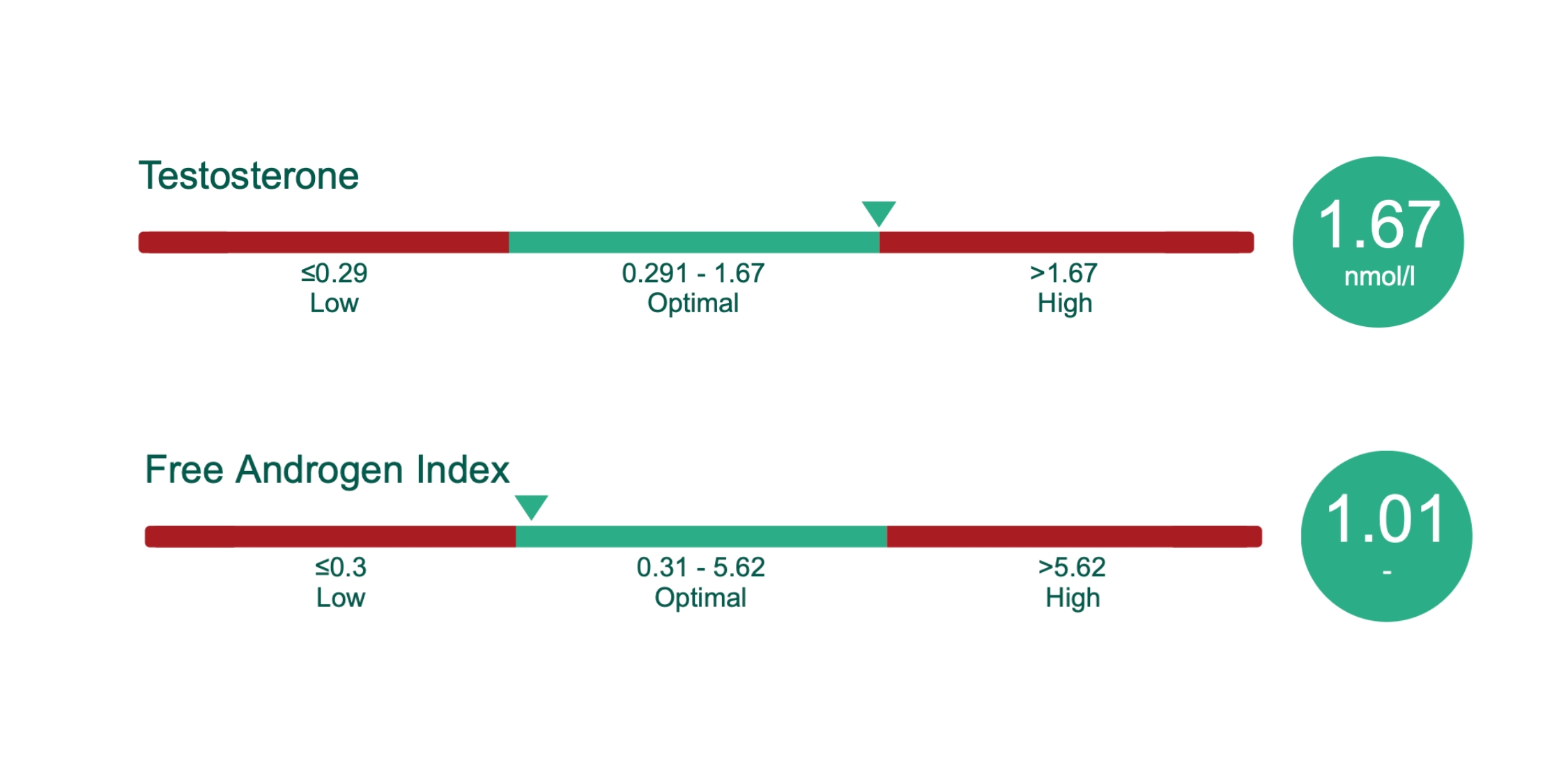
My testosterone levels were 1.67nmol/l during the time of testing in my early follicular phase, right on the upper limit of what’s considered ‘normal’ during a time of my cycle when my testosterone levels should actually be at their lowest.
All of my other hormone numbers came back as in-range, with Follicle stimulating hormone (FSH) and progesterone were all where they should have been at that point in my cycle.
This said, my free androgen levels (the ‘free’ non-bound testosterone available for by body to use) were a little on the lower side, so there’s definitely more nuance here, especially with the high SHBG picture above. Being keen to understand my hormonal and fertility baseline, in my early 30s, this is both a timely finding and a key watchpoint going forward.
Randox says: Testosterone is a male sex hormone, but it is also produced in small amounts by the ovaries and adrenal glands in women. Too much testosterone can lead to excessive hair growth on the face and body, acne, weight gain and irregular menstrual periods.
My next steps: Now, I know I don’t have PMOS, and I don’t experience any of these symptoms. But I have massively fallen off my exercise regime in the last 6 months or so.
Regular exercise (think aerobic activity paired with strength training) has been shown to improve metabolic health and balance hormones in women, so this is certainly an actionable lifestyle step I feel happy about taking, ahead of re-testing, 6 months down the line.
3. My Vitamin D level isn’t ideal

This one came as less of a surprise. I’ve always struggled with my vitamin D levels, and I’m a bit of a sunphobe. At the time of testing, my levels were sitting within the ‘insufficiency’ range.
Randox says: Vitamin D, an essential factor for calcium absorption, is generated by the skin following exposure to sunlight. Few dietary sources of vitamin D are available; therefore, when sun exposure is limited, deficiency is common. You may wish to consider taking a high strength over-the-counter vitamin D supplement.
My next steps: Time to go back to my vitamin D supplementation, especially as we’re currently heading into the dark half of the year in the Northern Hemisphere at the time of writing.
My tried and tested is the Bare Biology Unflavoured Vitamin D3 + K2 Spray, which delivers a whopping 4,000 IU (100 micrograms) of vitamin D3 per dose – if you don’t know, get to know.
How long does it take for Randox results?
Randox says results can start arriving from as little as two hours, with results typically available within one to two days once the sample reaches the laboratory, although individual tests can take longer.
I got my body composition results through almost immediately, followed by bits and bobs from the other tests trickling through day by day (including over the weekend) until my full downloadable report was ready exactly a week after.
My Randox Everywoman Review
So, was getting a women’s health blood test and check up in my 30s worth it? For me, yes, particularly because I went into it with a few very specific questions around fatigue, nutrition and my hormonal baseline, but ended up getting a much broader picture of my health.
I didn’t come away with a dramatic list of things “wrong” with me. In fact, most of my results were reassuringly good. What I did get were a handful of things to keep an eye on, some actionable lifestyle changes and a few useful questions to take to a healthcare professional.
And that’s probably the biggest takeaway for me.
A test like this can’t tell you everything about your health, and an abnormal result doesn’t automatically mean you have a medical condition. Results need to be interpreted alongside your symptoms, medical history and other relevant information, but having that baseline can give you something concrete to work from, particularly if you plan to repeat the testing and track how things change over time.
For me, the fact that Randox offers repeat testing after six months is super appealing. Rather than treating this as a one-off snapshot, I can use it as a starting point and see what changes when I make some different choices around exercise, nutrition and supplementation, alongside getting support from a doctor if I need it.
Use code TRBEVERYWOMAN10 for 10% off the Everywoman packages.
Keen to book your Randox Everywoman Complete? Hop over to their website here.
Want to hear more of our team’s experiences with Randox? Add this podcast episode to your playlist: The test that picked up low ferritin in my twin pregnancy, and how I’m navigating