

Can you see endometriosis on an ultrasound? What imaging can (& can’t) tell you, and the BCL6 test bridging the gap


It’s a common question from across our community, particularly among those of you dealing with infertility, repeated IVF failure, or pelvic pain symptoms: can you see endometriosis on an ultrasound?
The answer isn’t completely clear-cut (and we’re sorry!) but we’re committed to help educate and advocate for you in this area.
Enter the ReceptivaDx™ BCL6 test – a cutting-edge option helping identify hidden inflammation associated with endometriosis and shorten time to diagnosis and treatment, particularly in those experiencing unexplained infertility.
ReceptivaDx™ is also our go-to for all things endo, fertility and testing. So, in partnership with their expert team, we’re picking through the latest. Here’s what you need to know.
Getting diagnosed with endometriosis in 2026
Here’s the nutshell. Laparoscopic surgery is still considered the gold standard for diagnosing endometriosis.
This said, recently updated guidelines via the American College of Obstetricians and Gynecologists now support a more streamlined approach that allows healthcare providers to make a presumptive diagnosis based on your symptoms, medical history, physical examination, and imaging findings.
This shift aims to reduce the average diagnostic delay, which studies estimate can take up to 12 years. And if you’re on a fertility journey, you’ll know that time can feel so crucial, especially when multiple failed fertility treatments are stacking up.
That said, a key question remains: how often can symptom-based diagnosis alone provide enough clarity in real-world healthcare settings, where appointment time is limited and access to specialists can vary across the US?
Plus, your symptoms might be different to others that are more frequently listed (read up on some of the more uncommon ones here) or you might be completely asypmtomatic. And whilst ultrasound can be one of the first steps, it’s rarely the whole story.
Here’s the quick Q&A.
Can you see endometriosis on an ultrasound?
The answer is yes, sometimes. But there are one or two limitations.
A standard pelvic ultrasound may be performed through the abdomen (transabdominal ultrasound).
A transabdominal ultrasound can identify larger ovarian endometriomas and significant pelvic abnormalities.
However, image quality can be reduced because the ultrasound waves must travel through abdominal tissues before reaching the pelvic organs. As a result, smaller lesions are often difficult to detect.
What about a transvaginal ultrasound, can that detect endometriosis?
Yes. In fact, transvaginal ultrasound is currently considered a preferred first-line imaging test when endometriosis is suspected.
A transvaginal ultrasound places the probe inside the vagina, allowing much closer visualization of the uterus, ovaries, and surrounding pelvic structures.
Compared with abdominal ultrasound, transvaginal ultrasound will generally show:
- Higher-resolution images
- Better visualization of your ovaries
- Improved detection of deep infiltrating endometriosis
- More accurate assessment of your pelvic anatomy overall
For this reason, if you’re searching for endometriosis diagnosis with ultrasound, transvaginal ultrasound might be the examination you see being recommended.
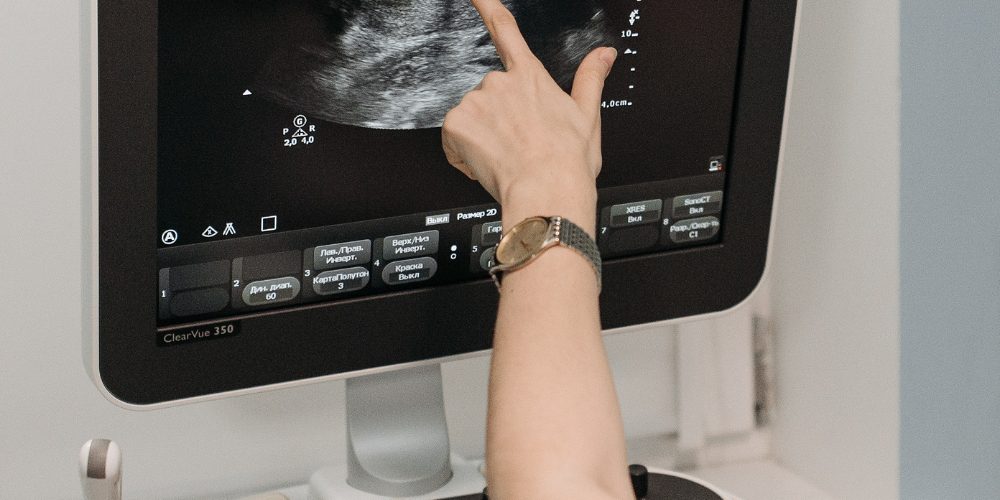
What does endometriosis look like on ultrasound?
What shows up on an ultrasound will depend on the type of endometriosis you have and where it’s located.
During an endometriosis ultrasound, your provider may be able to identify:
- Endometriomas (“chocolate cysts”) on the ovaries
- Deep infiltrating endometriosis
- Scar tissue and adhesions
- Thickened tissue between pelvic organs
- Reduced mobility of pelvic structures
Endometriomas in particular often appear as cysts containing old blood, giving them a characteristic appearance on ultrasound.
Getting specific, can deep infiltrating endometriosis be seen on ultrasound?
Yes, particularly when the scan is performed by a clinician experienced in endometriosis imaging.
Deep infiltrating endometriosis happens when endometrial-like tissue grows beneath the surface of pelvic structures.
Common sites include:
- The bowel
- The bladder
- The uterosacral ligaments
- The rectovaginal septum
Research has shown that specialized transvaginal ultrasound can detect many cases of deep infiltrating endometriosis with fairly good accuracy.
Can you diagnose endometriosis with ultrasound?
So, can you diagnose endometriosis with ultrasound? In some cases, yes.
An ultrasound can help identify certain forms of endometriosis, but it cannot definitively rule the condition in or out.
Certain lesions and ovarian cysts associated with endometriosis can be clearly visible. In many others, ultrasound findings may appear completely normal despite significant symptoms.
This is why ultrasound is considered an important diagnostic tool rather than a standalone diagnostic answer.
Can you miss endometriosis on an ultrasound?
Absolutely. One of the most important things to understand is that you can miss endometriosis on an ultrasound.
A normal scan does not necessarily mean endometriosis is absent, and you can receive normal imaging results while continuing to experience symptoms consistent with endometriosis, or no symptoms at all.
This is particularly true for:

What if you’re experiencing infertility, but have been told your imaging is ‘normal’?
If you’ve had a ‘normal’ ultrasound but are still struggling to conceive, whether you’re experiencing symptoms that suggest endometriosis or not, continue the conversation with your healthcare provider.
Depending on your situation, you could push for:
- A detailed symptom review
- Evaluation by a specific endometriosis specialist
- Further fertility-focused investigations
- BCL6 testing, to rule out or confirm inflammation associated with endometriosis
Where BCL6 testing fits into the picture
Searching for answers after months (or years) of unexplained infertility, recurrent implantation failure, or unsuccessful IVF cycles? ReceptivaDx™ offers a new pathway.
Their BCL6 test helps identify a biomarker associated with inflammation in the uterine lining, with a 96% positive predictive value. Elevated BCL6 levels are linked to endometriosis and other inflammatory conditions that may affect fertility.
Ask your provider about the test, if you’re experiencing:
- Unexplained infertility
- Repeated unsuccessful fertility treatments
- Symptoms suggestive of endometriosis despite normal imaging
- Ongoing pelvic pain without clear answers
Self-advocacy is so important, particularly on a fertility journey, and this test can help you do just that by building a fuller picture of what’s happening, rather than relying on a single result.
Tying it all together
So, can you see endometriosis on an ultrasound? The answer is, sometimes.
While ultrasound is an important first-line tool and can successfully identify ovarian endometriomas, deep infiltrating endometriosis, and other pelvic abnormalities, many forms of endometriosis are invisible on imaging, and a normal ultrasound does not exclude the condition.
Looking for answers about unexplained infertility, repeat IVF failure or symptoms that don’t match your scan results? Make ReceptivaDx™ and its first-of-its-kind BCL6 test your next step.
It can give you really valuable information that may otherwise be missed on imaging alone, and support you in making more informed decisions on your fertility journey.
Hop over to their website to find a testing partner near you, or start with a free 20 minute consultation to learn more. When you’re ready to move forward, you’ll be able to claim $75 off your test with code TRB26. Just pop it on your test request form.
Want to hear more from the ReceptivaDx™ team? Read this next: Endometriosis, infertility and IVF – Reddit’s top 17 questions, answered